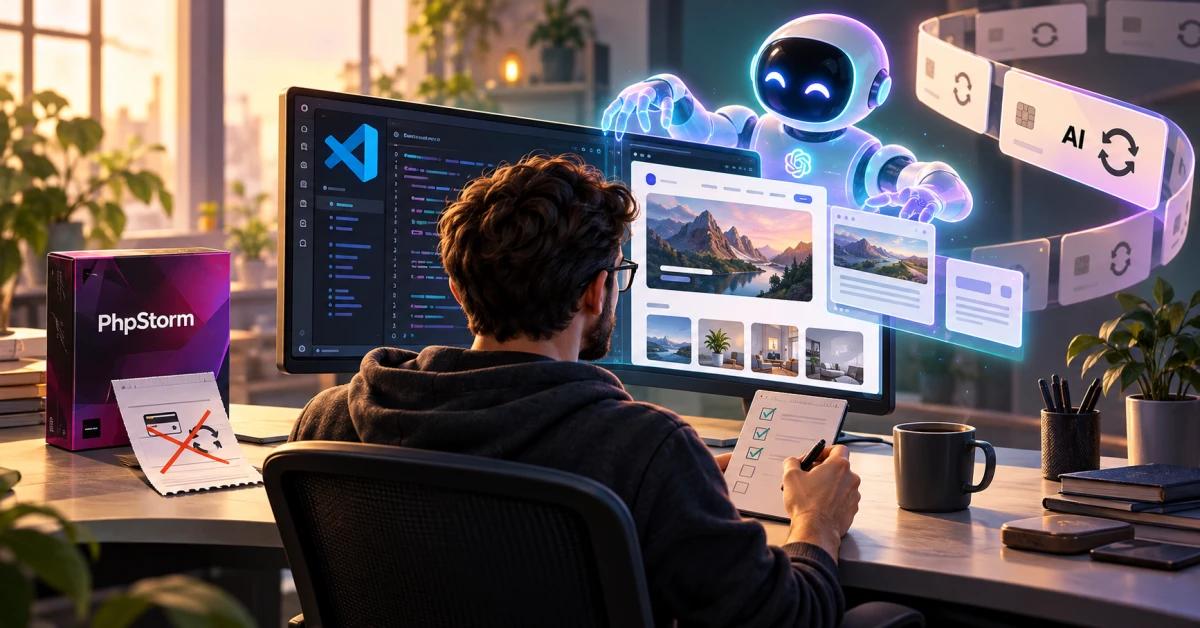
I left PhpStorm. After years of paying for a development tool, I started wondering whether that subscription still made sense when I could work with an AI application and VS Code.
My answer was to change tools. But the change revealed something that bothers me: AI helps me drop some subscriptions while taking its place in my budget as another almost essential subscription.
From May 2022 to October 2026
I looked through my order history. On May 5, 2022, there is a PhpStorm trial for zero dollars. In June and July 2022, there are payments of USD 10.68 each for a personal monthly subscription.
In the screenshots from August, September and October 2026, the amount is USD 7.80 per month, with a 40% continuity discount. These are the amounts in my own orders, rather than the prices every customer would pay today.
So I am talking about a product I was willing to pay for and returned to over the years. PhpStorm had a natural place in my work. I understood its value and accepted the cost.
Then AI changed the question. Instead of thinking only about the editor where I write code, I started thinking about the entire process of turning an idea into a result.
What AI actually “destroyed”
When I say AI “destroyed” PhpStorm for me, I mean my reason for continuing to pay for it.
A good IDE offers project navigation, completion, refactoring and debugging tools. Those things still have value. But the way I work has changed: I describe what I want, discuss an approach, request changes and check the result.
AI already does 99% of the work. I check the result.
In my current workflow, I estimate that AI already does 99% of the work. I provide the direction and make sure the output is correct: I review the code, test the functionality and check whether the interface looks and behaves the way I want.
When something does not match, I explain what needs fixing and check again. My role has become mainly coordination and review, while AI handles almost all the implementation. That 99% describes my experience; it is not a measurement that applies to every project or developer.
In this workflow, the editor takes on a different role. I need to see the files, read the changes and step in where necessary. And VS Code is free. Together with an AI application, it can be enough for what I choose to do.
PhpStorm also has AI features and integrations. My departure does not prove that the product has no future. It simply shows that the combination of tools worth paying for has changed in my case.
AI now competes with my other subscriptions for the same budget.
Why keep paying for an application if I can build what I need?
This raises a question bigger than choosing an editor. If I need a small tool for a specific task, should I immediately look for a subscription service?
Perhaps I need a converter, a script that processes files or a page where I track a few pieces of information. With AI, building my own version can become a realistic option. I can ask for exactly the feature I need without buying an entire package for a single button.
Of course, the code needs checking and the application needs maintenance. For some tasks, an existing service is worth the money. But simply having an alternative changes the discussion: the subscription has to justify its value more clearly.
That is what I like about AI. It lets me try ideas I might previously have abandoned because of the time or cost involved.
Then the AI bill arrives
This is where the paradox begins.
I drop one subscription because AI helps me do more with a free editor. But to use AI at the pace I want, I end up considering a paid plan, higher limits or additional usage charges.
The savings need calculating with every cost on the table. Removing PhpStorm from the list does not automatically mean I pay less overall. Perhaps I get more value. Perhaps the new expense covers more needs. It is still a recurring payment.
I dropped a subscription with AI’s help. Now I wonder how dependent I am becoming on my AI subscription.
“Essential” is not in the contract. You feel it in the competition.
Nobody forces me to buy AI. I can code without it. There are free options too, each with its own limits and requirements.
The pressure I feel comes from elsewhere: if I can move from an idea to a prototype faster, it becomes harder to ignore that possibility. I start seeing AI access as a necessary expense for keeping up and competing.
A subscription does not guarantee good ideas or correct code. I still have to choose the direction, understand the changes and take responsibility for the result. Yet the tool becomes so present in the process that its absence is noticeable.
How many subscriptions fit into one life?
Phone. Internet. Television or streaming. Hosting. A domain. Work applications. Now AI too.
Each service has a reasonable explanation for its price. But I pay for all of them from the same budget. And the list grows more easily than it shrinks.
When I say we have reached a point where we cannot exist without subscriptions, I am thinking about how much of our practical lives already depends on these payments. Work, communication, projects and our online presence each have a renewal date.
AI promises to help us build more ourselves. I want to use that possibility. But I also want to notice when a useful assistant becomes an expense I no longer dare to stop paying.
Why I left PhpStorm
For me, the combination of AI and VS Code changed the calculation. That is why I left. PhpStorm may remain the right choice for another developer, with different projects and priorities.
I chose to move part of my budget toward the way I work now. But I still ask myself the question that came with that decision:
If AI frees me from application subscriptions, how much freedom do I retain when I become dependent on an AI subscription?
AI gives us an ever wider range of things we can do. But if we always let it think for us, we risk becoming less capable of thinking for ourselves: we stop asking questions, stop checking and accept ready-made answers. Critical thinking fades when we stop using it. Being able to do more and more while understanding less and less — that is “Zvizdets”.